
about Audio, High Fidelity
& Home Entertainment technologies
pid: 662-2026/10/21 (v1.2)
Privacy Policy
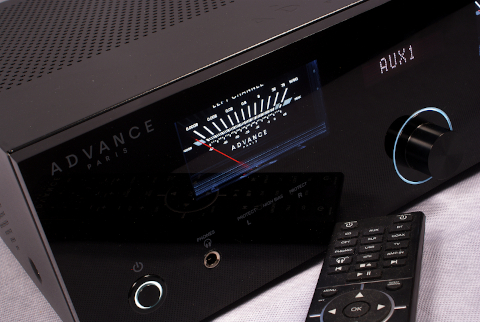
For the listening tests, the amplifier replaced our reference pre/power amplifier combination (Melos Plus Series Line/Parasound HCA3500) and drove our reference loudspeakers (ATC SCM-50PSL). I used both the analogue line-level inputs and the USB-B port for streaming from a computer, while a small portion of the listening sessions was conducted through the phono input.
Setting up the amplifier presents no particular difficulties. The usual rules apply, of course, and you will need adequate ventilation and airflow. The output-stage heatsinks are cleverly concealed inside the chassis, but they still need sufficient space around the unit to work effectively. The A8 Apex's menu system is well designed, with an intuitive layout. The rotary encoder feels good to use, as does the remote control. The power meters are the main feature of the front panel; they are calibrated in W/8Ω and dB, and their brightness can be adjusted. The preamplifier tubes also make their presence felt through the transparent window. The overall effect is warm and inviting.
The first impression with the A8 Apex in place of our reference amplification is that it has very good drive capabilities, despite its modest rated output. In our usual listening room, which is small to medium-sized, with the listening position approximately 2.5 meters from the loudspeakers, the results were unexpectedly good, and playback levels were comfortably high. This was accompanied by a sense of coherence and a refined presentation across the frequency range, creating a natural sound that was easy on the ear and invited long listening sessions without the slightest hint of fatigue.
All this suggests that Advance Paris has deliberately chosen not to impose an overt tube character on the amplifier, perhaps adding only a subtle signature that can be detected in its relaxed, very slightly laid-back presentation. The system sounds effortless, without the slightest trace of roughness. I suspect this is a deliberate strategy, one we have also encountered in the A12 Classic, which, incidentally, has a broadly similar measurement profile, although it falls noticeably short when it comes to high-frequency noise.


Looking at the details, the system proved entirely capable of handling the lowest octave, delivering good weight, convincing reproduction of impact, and a strong sense of control. The room fills with energy, and the presentation can be imposing when the material calls for it, without any hint of compression or hesitation from the amplifier. Bass is reproduced with convincing definition and fullness, with just the right amount of weight and never any exaggeration.
The bass region was reproduced with good articulation and a convincing sense of scale in the orchestral instruments. The result was clear, with a good sense of speed and detail retrieval. Rhythmic passages were also reproduced in a way that draws you into the music and makes listening a genuine pleasure. Weight, body, and speed combined with a strong sense of rhythm and flow.
The upper-bass and midrange regions sounded balanced and highly detailed, with a considerable ability to reproduce layering. Voices, choirs and recordings of large orchestras were vivid and present, with good separation between sections, convincing reproduction of movement and an accurate sense of air. Large-scale music really did sound large—a performance that is certainly impressive from an amplifier rated at 2*75W. I was left with the impression that Advance Paris had provided substantial dynamic headroom; the 1.3* increase in power when moving from 8Ω to 4Ω goes some way toward explaining this impression.
Stereo imaging is one of the amplifier's strongest points. The soundstage has particularly well-defined boundaries and a very good sense of depth, while individual sonic objects are focused with remarkable stability and convincing reproduction of movement and air. In recordings of large ensembles, the different sections were clearly delineated, while smaller ensembles benefited from exceptionally convincing reproduction of ambience and space. The A8 is one of the best integrated amplifiers we have heard in this respect, and it is probably no coincidence that the differences between its channels are exceptionally small.
The high-frequency part of the audio spectrum showed good extension and excellent transient characteristics. The amplifier sounds open and full while remaining easy on the ear, without becoming euphonically colored. It never becomes fatiguing or harsh, consistently favoring an enjoyable presentation without sacrificing detail. It reproduced the body and decay timing of metallic percussion very convincingly, with transients that leaned slightly toward the slower side. The resulting character is smooth and pleasant without becoming idiosyncratic. Could this be attributed to the tube stage? Possibly. If so, the French designers seem to know exactly how to work with the ingredients in their recipe and get the proportions right. The A8 does not flatter the music material or impose a character of its own. Just a pinch!
Speaking of character, users can experiment with the tone controls and, above all, try the loudness function. This feature may seem like a relic of another era, but it is far more than a charming extra: it compensates for the effect described by the Fletcher–Munson curves. In my view, it should be available as an option on every preamplifier, at least on those aspiring to serious performance. I don't know whether Advance approached it with this particular use in mind, but the A8 is exceptionally well equipped for situations in which listening at low levels is frequently necessary. Activate loudness, select the higher bias current to increase the power available in Class A (you certainly don't need more than 10W when listening quietly), and the amplifier is ready to go. Well done!
Finally, the phono input performed well. Low noise and, judging by the results, good tonal neutrality arising from accurate RIAA equalization provided a solid foundation for vinyl playback and the much sought-after analogue listening experience.
Conclusion
To conclude, the A8 Apex 30th Anniversary comes as no surprise. This is exactly the sort of product one would expect from Advance Paris, a company that has quietly become one of the most important manufacturers of affordable Hi-Fi equipment. The design is consistent yet inspired, the sound is of high-quality with a touch of laid-back refinement, the drive capabilities are good, and the amplifier offers a comprehensive range of connections and signal-adjustment options. We expected a strong performance, and that is precisely what we found in practice. Highly recommended if you're looking for a good, medium-power integrated amplifier.
Previous | Next | More Reviews
The .gr Domain
