
about Audio, High Fidelity
& Home Entertainment technologies
pid: 662-2026/10/21 (v1.2)
Privacy Policy
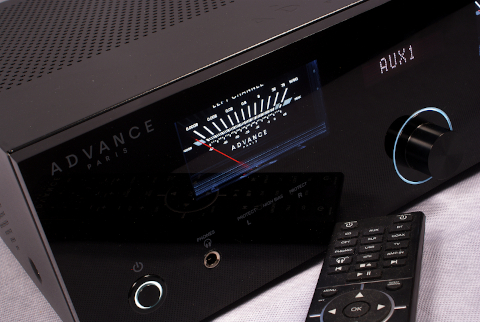
The Apex series chassis differs from that of the Classic range just enough to make it clear, on the one hand, that this is an entirely new and distinct product line, while also making it apparent, on the other, that the new series shares some of the same design ideas. Although this is largely a matter of personal taste, I find the new styling calmer and easier on the eye, with all the elements—the finish, display and meters—being a little more restrained, understated and refined. I would say that Advance Paris has taken a positive step forward here, and the A8 Apex is a handsome amplifier.

The new styling of the Apex series maintains its connection with the Classic range while adopting a cleaner, more refined appearance.
The carefully considered styling is paired with a sensible user interface based primarily on menus, which the user accesses through the rotary encoder that also serves as the volume control. The menus are displayed on a monochrome screen and allow input selection, access to the tone and channel-balance controls, and adjustment of the dynamic loudness compensation feature. The loudness control effect becomes more prominent at lower volume settings and is disabled at higher levels, as it should be. The menu also provides access to several secondary settings, including the startup volume after standby, display brightness, and automatic power-off when there is no signal at the input.
Apart from the analogue power meters, the amplifier's front panel keeps things fairly simple. It houses a headphone output (6.4mm TRS), three LED indicators—two for the protection circuitry and one for selecting the high-bias mode of the power stage—and a transparent window through which the preamplifier tubes are visible.

The user has a headphone output on the front panel. The three indicator LEDs show protection status and the selection of high-bias mode.

The volume control also serves as the encoder for navigating the menu. The display is highly legible, allowing settings and selections to be made from a distance using the remote control.
The A8 Apex offers more than a full complement of connectivity options. There are seven line-level inputs, an MM phono input, an HDMI/eARC port for connecting a television, and a comprehensive set of digital inputs, including one optical and two coaxial connections, plus a USB-B port for streaming from a computer. On the digital side, the amplifier can handle signals up to 24-bit/192kHz through all its digital inputs, and it also supports DSD streams up to DSD128 via USB.
The output options are equally comprehensive. These include a subwoofer output, with a fixed 200Hz low-pass filter at 12dB/octave, a preamplifier output, and a recording output. The user can also feed the power amplifier directly through its dedicated input, allowing the A8 to be integrated into a home entertainment system. If we were to be a little picky, we would have liked to see an MC phono stage and at least one balanced XLR input. On the other hand, the provision for Advance's A-BTC module is a welcome feature, adding the option of ad-hoc Bluetooth streaming.

The dual-triode tubes used in the preamplifier stage are impossible to miss.

The available connections are comprehensive, covering both analogue and digital sources.
All connectors are the usual gold-plated types. The speaker terminals accept cables with all common terminations and are easy to tighten securely. The supplied remote control is comprehensive, providing access to the menus while also allowing many functions to be activated directly, without navigating through them. These include tone controls, channel balance, loudness and mute.
Inside the chassis, one can find that the A8 Apex is typical of this type of product, with circuit boards arranged on two levels. The power supply is based on a generously sized toroidal transformer, which feeds a symmetrical solid-state power stage featuring two complementary pairs of output devices operating in Class AB. Here, Advance continues their tradition of allowing the user to select between two bias-current settings via a switch on the rear panel. This indirectly controls how much power the amplifier can deliver in Class A operation at low listening levels. In the Normal setting, the amplifier delivers 5W in Class A, while the High setting raises this figure to 10W. This is an interesting feature, particularly for listeners who regularly listen at low volume levels, as it lowers the crossover distortion inherent to class AB power stages.
The amplifier's hybrid architecture comes from the preamplifier stage, which is built around tubes—ECC81/12AT7 dual triodes, one per channel. This is an interesting approach that allows a certain degree of control over the unit's sonic character. The manufacturer can introduce a touch of tube character—the extent of which is, of course, an important design decision—while retaining the strong drive capabilities of a solid-state power stage, both in terms of output power and damping factor. The digital section is built around an ESS DAC, the ES9018.
The published specifications indicate that the A8 Apex delivers 2 * 75W into 8Ω and 2 * 110W into 4Ω.

This switch allows the user to adjust the bias current of the power stage. In the High On position, the bias current is higher, the amplifier runs slightly warmer at idle, and it delivers 10W in Class A.

The interior of the A8 Apex is complex, as you would expect from a unit that incorporates not only a power amplifier and preamplifier, but also a tube stage and a DAC.

The amplifier uses an ESS chip to convert digital signals to analogue and includes circuitry for tone adjustment and loudness compensation.

The power stage uses two complementary pairs of power transistors per channel. The heatsinks are located inside the chassis.

A large toroidal transformer with multiple secondary windings supplies the unit's various circuits, including the tubes.
Previous | Next | More Reviews
The .gr Domain
