
about Audio, High Fidelity
& Home Entertainment technologies
pid: 664-2026/11/04 (v1.2)
Privacy Policy
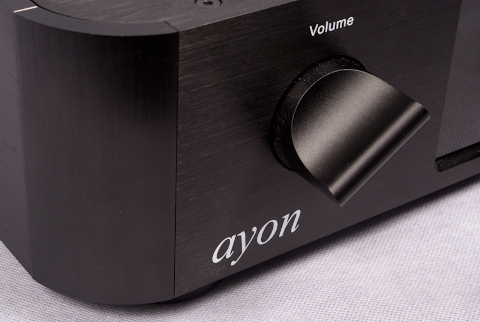
For the listening evaluation, the Iris replaced our reference digital sources (WiiM Pro/Teac Esoteric D70) and took over the task of driving the rest of the system (Melos Plus Series Line, Parasound HCA3500, ATC SCM-50PSL).
Most of the evaluation was carried out using Ethernet streaming, via UPnP/DLNA from a server and NAS. For a short period, we also used the unit as a conventional analogue preamplifier, replacing the Melos. In this configuration, the D70 fed its analogue input, while its single-ended output drove the Parasound. In all cases, the attenuator remained in the signal path, and the gain was set to "Low".
The Iris has standard dimensions and a reasonable weight, so it can easily be placed on the shelf of a conventional equipment rack. Its tubes do not generate much heat, so ventilation is not a particular concern, just ensure that there is some air space above. The unit is also straightforward to operate. You can use either the remote control or the app, and neither should present any difficulties.
The first impression you get when listening to the Iris is that of a pleasant, easygoing presence. Its presentation is particularly disciplined when it comes to imaging, with excellent scale and focus. The low frequencies are clean and fast, with a good sense of flow, while instruments body and weight are well conveyed. The treble is equally impressive, never becoming tiring. This makes extended listening particularly satisfying, if not something of a... must every time.
From the outset, it is clear that Ayon has made a conscious effort to avoid the trap of an exaggerated sonic character (the same approach we encountered in the S3 Junior ten years ago). With the Iris replacing our reference digital source, we got the full detail and frequency extension, with only minor differences compared with the reference, mainly in terms of very-low-frequency weight and the timing characteristics at the top end. Transparency, speed and dynamics are all there and, depending on the material, can be genuinely exciting.


Looking at the details, the Iris handles very-low-frequency information with ease. I got plenty of weight, a good sense of impact and an imposing presence in the room whenever the recording called for it. Control was firm, leaning towards the tight and fast, so clarity and a strong sense of presence were always assured.
The bass and upper-bass regions also reproduced at a high quality level. The Iris presents the body, impact, and scale of instruments in this range in a very positive and engaging way. They appeared with a convincing sense of presence, clearly positioned on stage, and without exaggeration. We are talking about a top-level digital source here, one that will immediately impress the demanding listener. The rhythm section had an excellent sense of flow, plenty of weight and substance, and sounded fast, clean, and strongly present in the room.
The reproduction of the midrange emerged as one of the unit's strongest points. With the image focused slightly behind the speakers' horizontal plane, the Iris created a very convincing impression of natural presence in the room, combining a well-balanced tonal brightness with an easygoing presentation. To make the system sound bright and tiring with the Iris, you would have to dig deep into your record collection and find material with exceptionally uneven tonal balance. Under normal circumstances, what you get is an effortless reproduction, and excellent description of layering and overall image. To this, we should add the very good description of voice. Its tonal balance, the convincing presentation of ensembles and soloists, and the precision with which Iris conveys articulation and timbre complete the picture of a digital source of considerable caliber.
Speaking of imaging, the Iris performed at a very high level in its presentation of the soundstage. I got a disciplined and clearly defined stage, excellent stability in the focus of audio objects, and very good sense of depth. The listener is treated to an excellent feeling of air, atmosphere and movement, and the unit does justice to every carefully produced mix, placing the details accurately in the listening space.
At the top end, the Iris showed good extension and excellent timing characteristics. The attentive listener will appreciate its smooth, gentle character, which does not obscure detail. Instead, it adds a pleasant emphasis to the reproduction of percussion instruments in this range and offers harmonic richness that is far from embellished. There is a generous sense of warmth, perhaps with a slight tendency towards a somewhat rounded overall result. What you get is good speed and detail, presented with a certain consideration for the listener. I was left with the impression that you could listen for hours without ever feeling the need to turn down the volume, as the Iris has very good capabilities in terms of macro-dynamics and dynamic contrast. Quite an achievement!
As a dedicated analogue preamplifier, the unit is also particularly appealing sonically. It has low noise, produces a good image, and has proven capable of making the most of a top-class source without hiding anything. If you don't need multiple sources or complex routing options, the Iris can perform this role very effectively.
Conclusion
The Iris is a particularly convincing proposition for anyone looking for a digital source with a balanced character and serious capabilities in terms of detail and dynamics. It goes a step further by offering a well-judged overall presentation that stays true to the principles of top-quality Hi-Fi. The Austrian company knows its way around tubes and does not sacrifice the real goal in pursuit of impressive but ultimately unnecessary excesses. It achieves this through a realistic design and choice of architecture, meticulous attention to build quality, and a feature set that leaves nothing out. If you are shopping in this price bracket and looking for something unique and remarkable, it comes highly recommended!
Listening Sessions Recording
The following recordings were made with a DV-RA1000 Tascam master recorder (using 24bit/192kHz sample rate) and you can download them to have an impression of what the device under review sounded like. It is obvious that any recording of this kind could not be absolutely transparent but, according to our experience, the majority of sound attributes we listen to, during the actual listening sessions, are preserved. No need to say that you should use these samples cautiously and for informative purposes only. Do not rely on them exclusively to make any buying decisions. The file format is .flac, so expect that the zipped files will be quite large (even if the clips are about a minute or less long. You could use an ABX listening tool like the ABX plug-in for foobar2000 if you want to make some more elaborate experiments. Contact us if you have any questions.
| Listening Sessions Recording TOC | |
|---|---|
| Tracks #01-04 | Ayon Iris XS, Ethernet, 16-bit/44.1kHz. |
| Tracks #05-06 | Ayon Iris XS, Ethernet, 24-bit/96kHz. |
| Reference | Teac Esoteric D70 | dCS Puccini U-Clock. |
Previous | Next | More Reviews
The .gr Domain
